

Agricultural Drones: The Technical Infrastructure of Smart Farming
Agricultural Drones: The Technical Infrastructure of Smart Farming
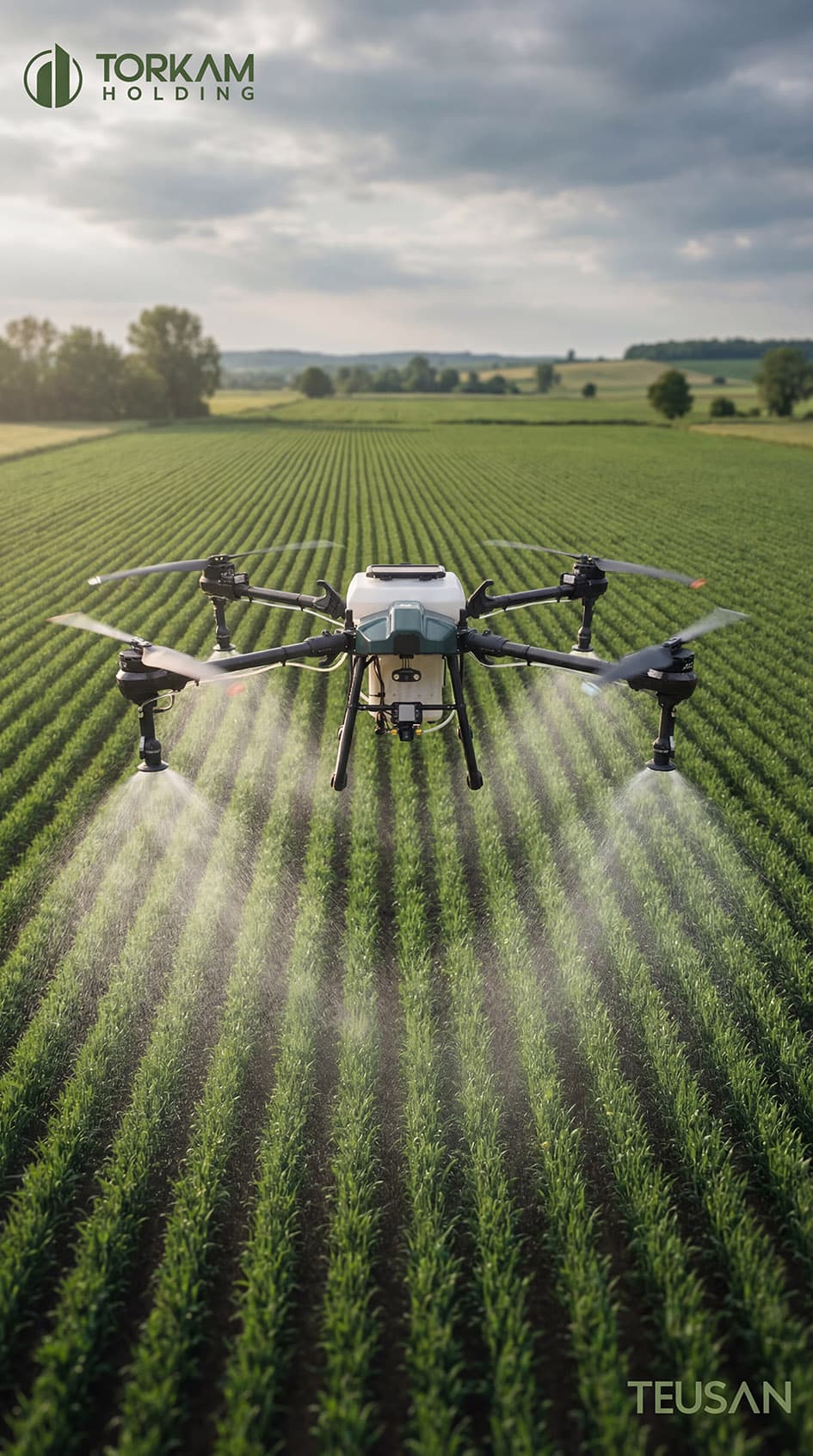
Agricultural Drones: The Technical Infrastructure of Smart Agriculture
In modern agriculture, productivity is no longer driven solely by seeds and soil; it is increasingly enabled by software and sensor technologies. Agricultural drones—particularly multirotor platforms—now deliver substantial advantages over conventional methods in crop spraying, fertilization, and field mapping operations.
TEU-AGR 01 features an integrated architecture comprising a flight controller, pump system, flow meter, and GNSS module. Through AB Mode, the drone executes parallel flight paths between two operator-defined reference points, systematically covering the field. Turn-point velocity profiles are automatically calculated by the onboard software to ensure optimized trajectory management and uniform application.
Within the spraying system, flow sensors dynamically regulate pump output based on real-time ground speed. This ensures a constant application rate during acceleration and deceleration phases, resulting in homogeneous and measurable coverage. The target dosage (L/min) is calculated in real time by the flight software on a per-square-meter basis, enabling precision application.
To address field obstacles such as trees, utility poles, and irrigation channels, radar and Time-of-Flight (ToF) sensors are employed. These systems generate real-time distance data and transmit immediate maneuver commands to the flight controller. TEU-AGR 01 operates in full integration with these sensors, ensuring safe and reliable in-field operations.
Advantages Over Conventional Methods
The contribution of agricultural drones extends beyond automation; it represents measurable gains in cost efficiency, operational productivity, and environmental sustainability.
Traditional backpack sprayers or tractor-mounted systems may require several hours to treat large fields. TEU-AGR 01 can spray 25–30 decares within 15 minutes—significantly reducing labor time. Speed becomes a critical factor, particularly during pre-harvest windows and time-sensitive crop protection cycles.
Its precision spraying system applies chemicals strictly to the target area, delivering 30–50% agrochemical savings compared to conventional techniques. Drone operations remain uninterrupted in sloped, narrow, or waterlogged terrains where tractors cannot operate effectively, while eliminating direct operator exposure to chemicals. All flight data and application logs are monitored and recorded through the TeusanGCS interface, enabling traceability and reporting.
TEU-AGR 01 can maneuver seamlessly along marsh edges, steep orchards, and tight row spacings where tractors or manual labor cannot access. This ensures complete and uniform field coverage, preventing untreated zones from becoming disease or pest hotspots.
Unlike manual backpack spraying, where workers are exposed to toxic chemicals for extended periods, drone-based operations reduce chemical contact to near zero. The operator manages the system remotely from a safe distance.
Beyond spraying, TEU-AGR 01 records flight routes, applied flow rates, and geospatial field coordinates. Through the TeusanGCS interface, data can be monitored in real time and past missions can be reported, allowing farmers to document agrochemical input per parcel with full transparency.
The atomization nozzles used in spraying break the liquid into ultra-fine droplets, enhancing leaf underside penetration. This approach reduces chemical drift and minimizes off-target dispersion.
Developed by Teusan, the AGR 01 platform is engineered with domestically developed software and indigenous engineering expertise. Fully integrated with the TeusanGCS interface, AGR 01 offers rapid field deployment, precision atomization, and reliable autonomous flight performance—positioning it as a purpose-built solution tailored to the operational demands of modern agriculture.